

Most global organizations treat brand architecture as a naming exercise: a portfolio spreadsheet of logos, sub-brands, and visual systems designed to create aesthetic consistency.
In personal genetics and biotechnology, that view is outdated. Here, architecture is a trust infrastructure and, increasingly, a capital allocation system, and not a cosmetic decision.
That shift matters because the asset moving through the brand is no longer just a product or service. It is biological identity, personal risk, and the cultural meaning attached to it.
As brand strategist Erich Joachimsthaler argues1, brand architecture is entering a “Second Era” in which the center of gravity shifts from portfolio clarity toward capital efficiency.2 In this logic, brand portfolios behave less like naming systems and more like financial systems, with brands competing across specific demand spaces.
So, once again, the brands that scale best will be those with structures capable of carrying trust3 across different regulations and cultural expectations4. This is why the next frontier is the convergence between brand architecture and Digital Cultural Intelligence (DCI).
Architecture Is the Structure of Trust
Brand architecture defines how a company’s brands relate to one another and how those relationships are understood by the market. At its most familiar, it falls into three models:
- A Branded House concentrates authority on a single master brand.
- A House of Brands distributes risk across independent brands.
- A Hybrid or Endorsed model balances the credibility of a parent company with the flexibility of distinct market-facing offers.
In genomics, these choices determine whether a consumer believes a company is safe enough to handle sensitive data.
This is where Digital Cultural Intelligence (DCI), the organizational ability to operate effectively across digitally mediated cultural environments, becomes essential.
Its four dimensions (metacognitive, cognitive, motivational, and behavioral) provide a framework for understanding not only what audiences do, but how trust is formed in specific contexts.
| DCI Pillar | Strategic Application | Objective |
| Metacognitive | Reflecting on cultural assumptions; monitoring digital signals. | Strategy: Real-time adjustment of positioning. |
| Cognitive | Understanding legal norms (GDPR, IVDR) and social structures. | Interpretation: Compliance as a signal of respect. |
| Motivational | The intrinsic energy and willingness to engage with diversity. | Execution: Reducing resistance to change. |
| Behavioral | Adapting tone, channel, and communication style (e.g., WeChat vs. WhatsApp). | Optimization: Authentic emotional resonance. |
The Global Map of Genetic Trust
The global genomics market5 is expanding rapidly. According to Fortune Business Insights, it was valued at $34.23 billion in 2025 and is projected to reach $38.24 billion in 2026 and $99.26 billion by 2034. But the market is not culturally uniform, and architecture must respond to how trust is built regionally.
Europe: Trust Through Regulation
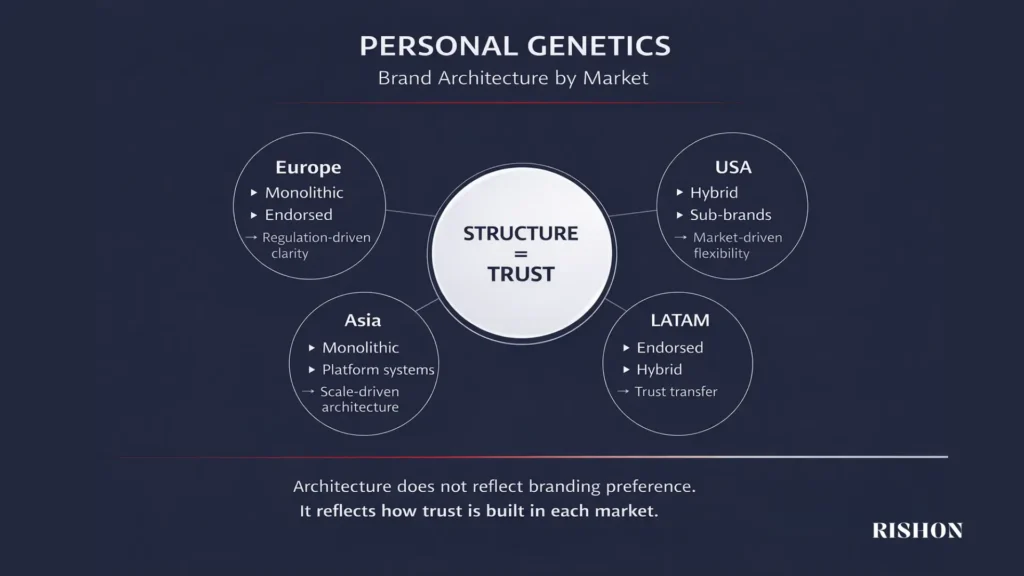
In Europe, trust is closely tied to regulatory legitimacy.6 The In Vitro Diagnostic Regulation (IVDR) has been applicable since May 26, 2022, reinforcing compliance as a visible sign of scientific seriousness. This is further layered by the EU AI Act7, which entered into force in August 2024 and becomes fully applicable on August 2, 2026, while the European Health Data Space (EHDS) entered into force in March 2025 .
Because 90% of the European medtech sector is made up of SMEs, the cost of compliance can make clearer monolithic or endorsed structures especially persuasive as trust anchors.
The DCI priority8 here is largely Cognitive: understanding the cultural meaning of privacy and institutional accountability in European markets.
North America: Trust Through Segmentation
North America was the largest regional market in 2025, with a 43.04% global share9. Here, trust is often built through choice, differentiation, and category-specific messaging.
Historically, 23andMe exemplified a two-sided data-banking market model using a hybrid architecture to separate consumer-facing ancestry from research database value. Even as early market pioneers face structural shifts, with 23andMe filing for Chapter 11 in March 202510, the conceptual strategy of hybridizing health and ancestry to manage user control remains a dominant template in the U.S.. The DCI focus is Behavioral: adjusting tone and interface for different publics without dissolving parent equity.
Asia Pacific: Trust Through Scale
Asia Pacific is expected to post the highest CAGR over the forecast period. In several Asian markets, legitimacy is closely linked to platform power and systemic integration.
BGI Group11 is one of the clearest examples. Its structure connects research, production, and sequencing through a highly integrated ecosystem that includes BGI Genomics, MGI, and STOmics. This “Big Science” approach signals capability through integrated research, production, and high-throughput sequencing infrastructure. The DCI emphasis is Metacognitive: reading digital environments and sustaining one coherent authority across vast super-apps.
LATAM: Trust Through Relationship Transfer
In Latin America, trust is often built through proximity and intermediation. Legitimacy is gained faster when innovation is validated by existing credible entities like doctors and clinics.
Brazilian player Genera12 illustrates this logic by building partnerships with physicians, clinics, and partner units that embed genetic services inside existing care relationships. In these contexts, trust behaves like a transferable asset, moving through professional networks before settling into the brand. The DCI priority is Motivational: the willingness to engage local relationship realities seriously rather than assuming trust can be exported intact.
Data Explains Behavior. DCI Explains Meaning.
The strategic equation for 2026 is simple:
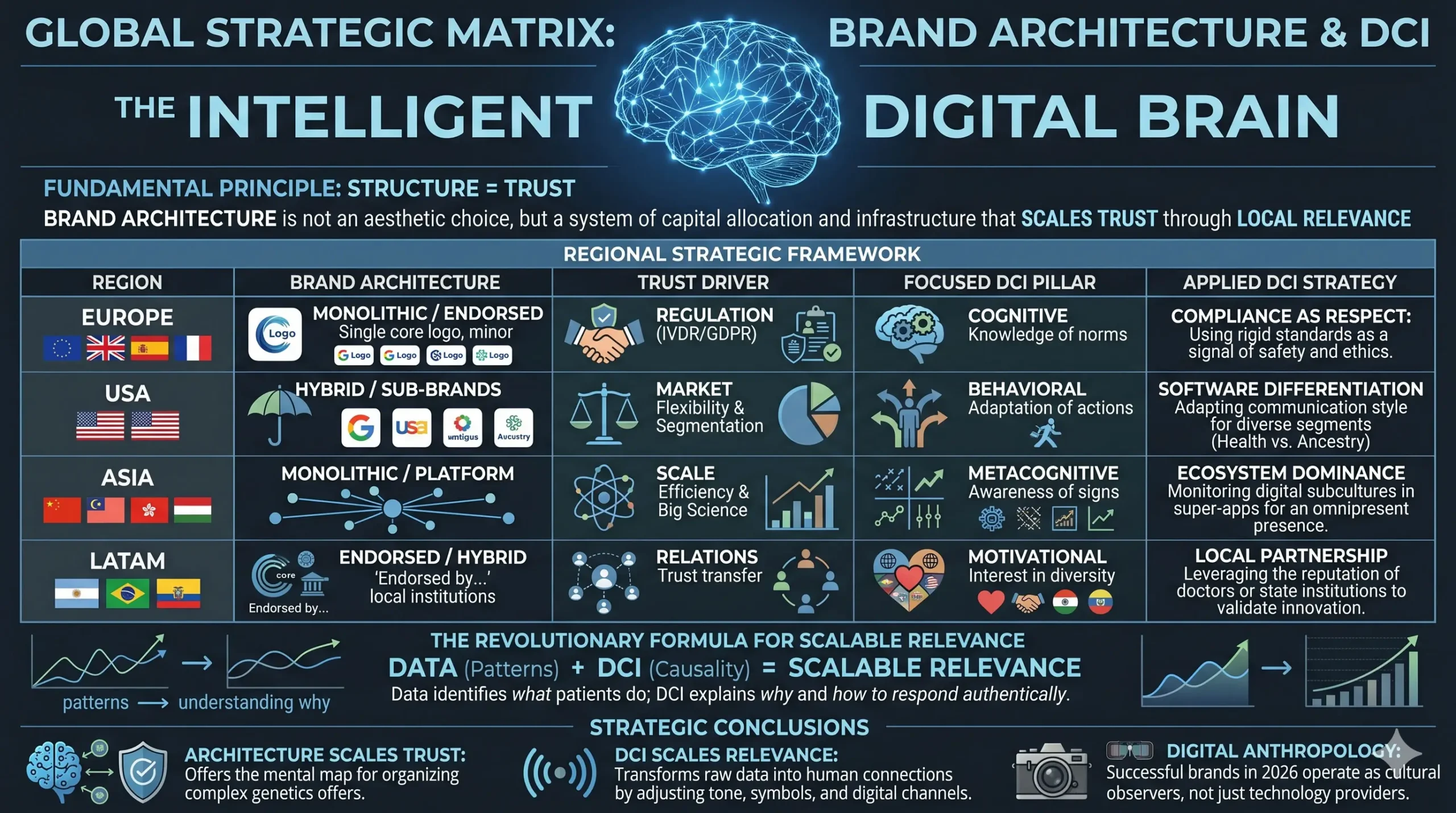
Data (Patterns) + DCI (Causation) = Scalable Relevance
Data tells a company what people click, buy, or abandon. But it cannot, by itself, explain why a patient hesitates to share genetic data in one region while embracing it in another. That explanatory layer is cultural. Without it, global scale becomes blunt force.
For this reason, the next-stage genomics company must evolve into what Accenture calls an Intelligent Digital Brain13: a unifying layer that captures institutional memory, operational context, and decision logic across the organization. This system transforms generic AI into domain-specific intelligence, allowing enterprises to see clearly across systems and execute with proprietary context.
| Region | Architecture | Driver | DCI Focus | Trust Source |
| EUROPE | MONOLITHIC / ENDORSED | Regulation-driven (IVDR/GDPR) | Cognitive | Compliance with strict standards. |
| USA | HYBRID / SUB-BRANDS | Market-driven choice & segmentation | Behavioral | Flexibility to target niche segments (Health vs. Ancestry). |
| ASIA | MONOLITHIC / PLATFORM | Scale-driven efficiency | Metacognitive | Integration into super-apps and large-scale ecosystems (Big Science). |
| LATAM | ENDORSED / HYBRID | Relationship-driven validation | Motivational | Using the credibility of local partners (physicians, government) to validate the technology. |
Visual Identity Is the Final Layer, Not the First
Typography and contrast reinforce the architecture of trust, but they cannot replace it. A visual system built with Montserrat can project modern authority; one built with Gotham can suggest institutional stability; one using Poppins can soften complexity through digital approachability. These choices are only effective when they sit on top of a structure that already makes sense culturally and strategically.
In global genomics, brand architecture is no longer about design coherence alone. It is about whether a company can create a system of meaning strong enough to carry biological data and regulatory scrutiny at the same time. If your structure does not align with how trust is formed locally, the brand is not just underperforming, it is misreading the market.
Notes:
- https://medium.com/%40ejoachimsthaler/brand-architecture-is-entering-its-second-era-67d121961494 ↩︎
- https://medium.com/%40ejoachimsthaler/portfolio-strategy-and-brand-architecture-as-capital-allocation-bbd9c78c5bcf ↩︎
- Genetic Data: Potential Uses and Misuses in Marketing – Remi Daviet, Gideon Nave, Jerry Wind, 2022 ↩︎
- The consumer genome: Willingness to share and accept genetic data in marketing | Electronic Markets | Springer Nature Link
↩︎ - Genomics Market Size, Share, Industry Growth Report 2034 ↩︎
- New Regulations – Public Health – European Commission ↩︎
- AI Act | Shaping Europe’s digital future ↩︎
- Digital cultural intelligence and its role in enhancing expatriate work adjustment: A configurational approach in global work environments | PLOS One ↩︎
- Genomics Market Size, Share, Industry Growth Report 2034 ↩︎
- https://mediacenter.23andme.com/press-releases/23andme-initiates-voluntary-chapter-11-process-maximize/ ↩︎
- BGI Group Official Website ↩︎
- Parcerias – Genera | Junte-se a nós em soluções de testes genéticos ↩︎
- https://www.accenture.com/il-en/insights/data-ai/intelligent-digital-brain ↩︎