

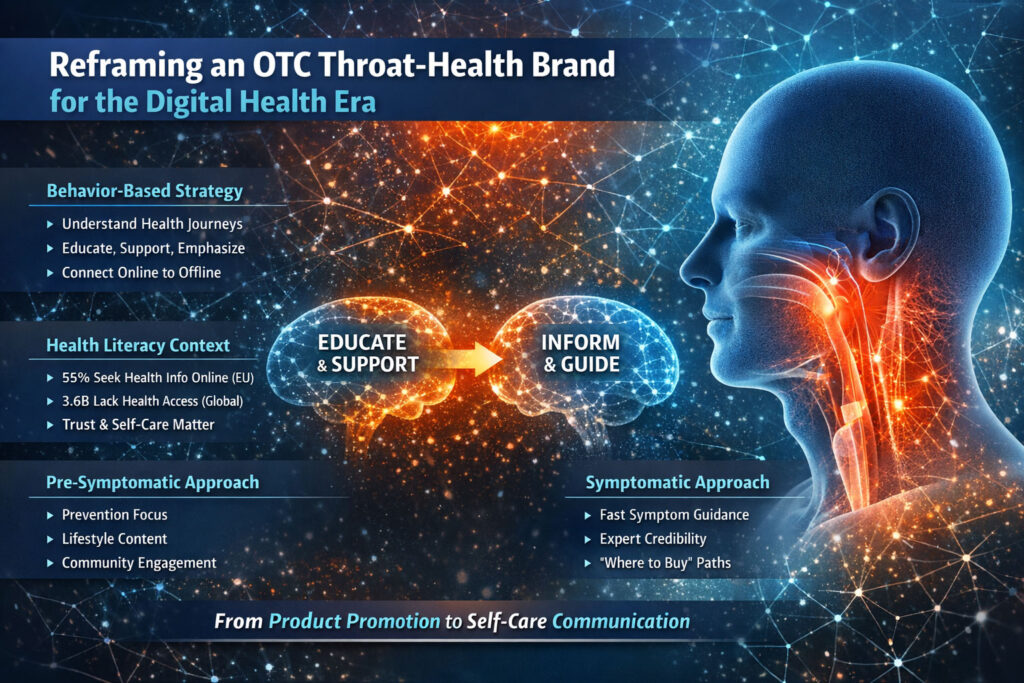
This project for a confidential OTC brand challenged the traditional, linear sales funnel. In self-care, consumers move fluidly between prevention, symptom recognition, and professional reassurance. Our strategy shifted the brand from product-first promotion to a behavioral communication model, integrating the brand into the broader digital health journey rather than treating it as a seasonal purchase.
Context: The Digital Health Shift
The logic of this 2019 project is now a market standard. In the EU and US, nearly 60% of adults use the internet as their primary source for health information and care navigation.
- The Reality: Health communication now unfolds in a digital environment where search, comparison, and reassurance are “business as usual.”
- The Goal: As per WHO guidelines1, digital health success requires integrating information into the human context. Communication in self-care is a translation task: making medical information usable, not just visible.
The Challenge: From Demographics to States
Most OTC marketing treats the audience as a demographic. We treated them as behavioral states, recognizing that timing changes meaning. We mapped the strategy across two distinct realities:
- The Pre-symptomatic State: Focus on awareness, preventive value, and building “mental availability” before the need arises.
- The Symptomatic State: Focus on fast orientation, credible guidance, and reducing friction in the path to purchase.
Strategic Response: The “Educate, Support, Emphasize” Framework
Instead of a slogan, we built a communication architecture designed to provide interpretation, not just facts:
- Educate (Search Moment): Symptom-based content clusters and prevention guidance to capture high-intent searches.
- Support (Social Layer): Utilizing peer stories, expert-backed reviews, and testimonials to build trust (addressing the misinformation gap noted in recent JMIR studies2).
- Emphasize (Memory & Access): Online-to-offline pathways (“where to buy”) and transmedia storytelling to ensure brand recall at the moment of urgency.
Why It Matters
This approach aligns with a massive shift toward self-management. With EU3 preventive health expenditure reaching €90.4 billion (2022), a throat-health brand gains more relevance by acting as part of a preventive ecosystem rather than just a “fire extinguisher” for symptoms.
Outcome
As a confidential pitch, this case demonstrates a DCI (Data, Context, Insight) approach in practice. It reframes a commodity product into a behavior-aware health partner by mapping how people actually search, fear, and trust in the digital age. It moves the needle from “talking louder” to “being more useful.”