

This was a confidential strategy project for a brand operating in the personal genetics / genetic testing space, within the broader context of personalized and genomic medicine.
The work focused on audit, analysis, and brand positioning. The central challenge was not visual differentiation alone, but strategic coherence.
In genetics, brands are rarely interpreted only through design. They are read through a mix of trust, clinical seriousness, usability, scientific credibility, regulatory sensitivity, and human meaning.
Our role was to clarify where the brand should sit in a fast-evolving category, and to define a position that could feel credible to the market, relevant to the audience, and useful to the business.
Market Context
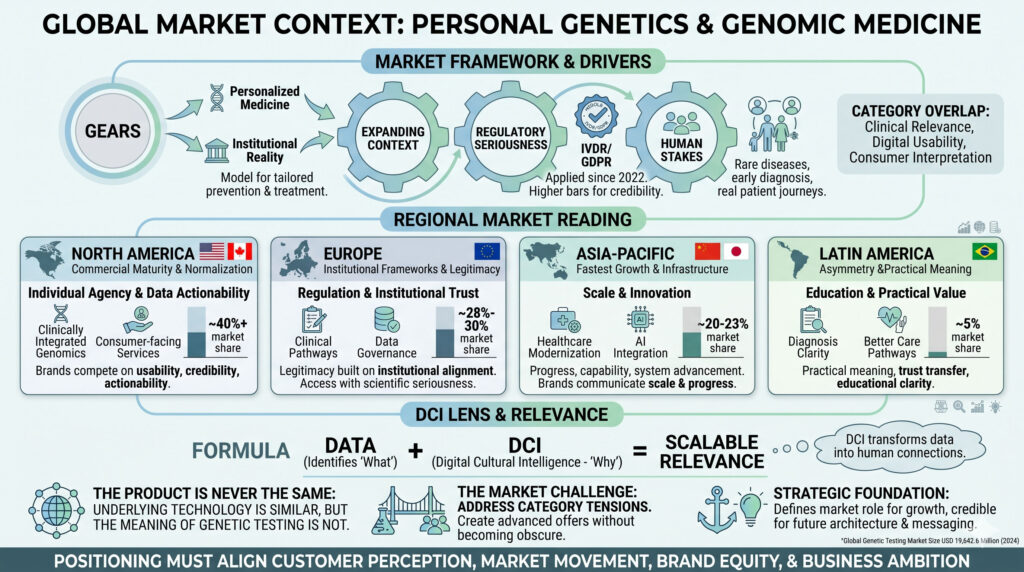
The category sits inside a much larger healthcare transformation. At policy and clinical level, personalized medicine is increasingly framed as a model that tailors prevention and treatment more precisely to the characteristics of individuals. In parallel, genomic medicine is already influencing areas such as oncology, pharmacology, infectious disease, and rare or undiagnosed conditions.
For this project, however, the most relevant competitive field was narrower: personal genetics / genetic testing, especially where clinical relevance, digital usability, and consumer interpretation begin to overlap.
That category has become more consequential in recent years for three reasons.
First, the medical and public-health context is expanding. Personalized medicine is moving from abstract promise to institutional reality, supported by large-scale research and policy initiatives in multiple regions.
Second, the category is becoming more regulated and more serious. In Europe, for example, the In Vitro Diagnostic Regulation (IVDR) has applied since 26 May 2022, raising the bar for credibility and reducing tolerance for vague or loosely framed claims.
Third, the human stakes are high. In health-adjacent categories such as rare disease, early diagnosis, and preventive care, complexity is not theoretical. It affects real patient journeys, family decisions, and trust in healthcare systems.
In that kind of environment, branding is not cosmetic. It helps determine whether a complex offer feels credible, legible, and worth trusting.
The Challenge
Most brands in personal genetics face the same structural problem: they communicate from science outward, while audiences experience the category from life inward.
People do not usually encounter genetic testing first as a technical system. They encounter it through uncertainty, aspiration, clinical need, family anxiety, research relevance, or the promise of more personalized care.
That makes positioning unusually difficult. Too much:
- technical language creates distance.
- lifestyle language weakens trust.
- futurism makes the offer feel speculative.
- clinical seriousness can make it feel inaccessible.
The challenge in this project was to define a position strong enough to hold those tensions without collapsing into generic healthcare language or abstract innovation rhetoric.
It had to be commercially useful, strategically defensible, and understandable to the market.
Our Strategic Response
We approached the work through four lenses: market, brand, business, and client.
That mattered because, in a category like personal genetics, positioning cannot be built from internal preference alone. It has to align with:
- customer beliefs and anxieties,
- category expectations,
- competitive behavior,
- existing brand equity,
- and the business objectives the brand needs to support.
The audit framework made that explicit. The right brand position is the one that aligns customer perception, market movement, existing brand equity, and business ambition.
The analysis benchmarked how leading players in personal genetics and adjacent genomic diagnostics were expressed:
- brand architecture,
- portfolio logic,
- naming systems,
- symbolism,
- color use,
- and market-facing clarity.
What emerged was a category moving in two directions at once.
- On one side, leading brands were becoming more clinically serious, more modular, and more portfolio-driven.
- On the other, they were also becoming more accessible, more human, and more legible across digital touchpoints.
As genomic medicine becomes more mainstream, brands have to communicate both expertise and intelligibility. They need to feel advanced without becoming obscure.
The DCI Lens
This is where Digital Cultural Intelligence (DCI) became useful.
The project was not only about what competitors looked like. It was about how the category is understood.
In personal genetics, the product is not just a test, platform, or service. It is a promise about knowledge. And in health, knowledge is never interpreted neutrally. It is filtered through emotion, context, health literacy, trust in institutions, trust in science, and the extent to which the brand makes complexity feel usable.
That made coherence more important than decoration.
The goal was to define a market role the brand could own credibly, then build the strategic logic that would make future identity, messaging, and architecture feel consistent rather than arbitrary.
Regional Reading of the Category
The regional analysis was used to understand how the meaning of genetic testing shifts by context, and what that implies for positioning.
North America
North America is currently the most commercially mature market in genetic testing, holding over 40% of global market share depending on source and category definition1.
Our analysis suggested that what defines this market is not just scale, but normalization. Genetic testing has long been visible through direct-to-consumer models, which helped establish the idea that genetic data can be accessed, interpreted, and used outside traditional clinical pathways.
That created a dual-layer market:
- clinically integrated genomics linked to oncology, rare disease, and pharmacogenomics;
- and consumer-facing genetic services linked to ancestry, wellness, and self-knowledge.
From a positioning standpoint, this makes the market highly competitive in meaning. Brands are not competing on awareness alone. They are competing on whether the offer feels usable, credible, and actionable.
Europe
Europe is structurally different because the category is shaped less by consumer normalization and more by institutional frameworks.
Depending on source and market definition, Europe represents roughly 28–30% of global share. But the more important point is not size. It is the way legitimacy is constructed.
Genetic testing in Europe is more closely tied to clinical pathways, prevention models, public healthcare systems, data governance, and regulatory oversight. That creates a communication environment in which credibility depends heavily on clarity, seriousness, and institutional alignment.
From a strategic point of view, the market may move more cautiously, but it rewards legitimacy more strongly. The positioning challenge here is not simply accessibility. It is accessibility without loss of scientific or regulatory seriousness.
Asia-Pacific
Asia-Pacific is the fastest-growing major region in genetic testing and currently accounts for roughly 20–23% of global market share, depending on source2.
Our analysis suggested that the distinctive feature of this region is the speed at which infrastructure, adoption, and technological ambition evolve together.
In some markets, genetics is closely associated with large-scale healthcare modernization, AI integration, and state-backed innovation. In others, growth is driven more by increasing access, private healthcare expansion, and rising demand for earlier diagnosis.
From a positioning perspective, the category often reads less as personal exploration and more as progress, capability, and system-level advancement. That creates room for brands that can communicate scale and innovation without becoming impersonal.
Latin America
Latin America remains a smaller market by revenue, at roughly 5% of global share, but it shows consistent growth.
What stood out in our analysis was asymmetry. Access to advanced genetic testing exists, but unevenly. Awareness is growing, but affordability, trust, and clinical translation remain barriers in many contexts.
That changes the communication task. The problem is not market saturation. It is practical meaning.
Brands in this context need to explain not only what the technology does, but why it matters in immediate, human terms: earlier diagnosis, clearer decisions, better care pathways, and reduced uncertainty.
From a strategic standpoint, this makes trust transfer and educational clarity especially important.
Why the Category Reads Differently Across Regions
The category is growing globally, but growth alone does not explain market behavior.
The deeper variation comes from how each system interprets health, data, trust, and medical authority.
Our strategic reading was:
- North America tends to privilege individual agency, data access, and actionability
- Europe places more weight on regulation, clinical integration, and institutional trust
- Asia-Pacific often rewards scale, innovation, and visible system capability
- Latin America places stronger emphasis on access, education, relational trust, and practical value
From a DCI perspective, this means the product is never the same product everywhere.
The underlying technology may be similar. The meaning of genetic testing is not.
That is why positioning in this category cannot be globally generic by default. It has to be structurally and culturally aware, or it risks becoming too abstract, too technical, or simply irrelevant.
What Work Delivered
The output was not a campaign line. It was a stronger strategic foundation.
The audit and analysis clarified the market role the brand could credibly occupy, identified the positioning logic most likely to support growth, strengthened the basis for future architecture, messaging, and identity decisions, and moved the brand from a visual or intuitive idea of itself toward a more disciplined market position.
That is often the real value of strategy in complex health sectors. It makes the brand easier to place, to explain, and to trust.
Outcome
Because this was a confidential strategic project, no public brand name, internal deck, or implementation metrics are included here.
The value of the work sat elsewhere: in creating a clearer market-facing direction, stronger commercial credibility, and a more coherent basis for stakeholder communication.
It gave the brand a positioning logic better matched to the realities of personal genetics today: a category in which clinical relevance, scientific trust, digital legibility, and human meaning must now coexist.